

Spark to Shaft
Abstract
Abstract
Aim:
To design and simulate a simplified single-cylinder, 4-stroke spark ignition (SI) engine piston-cylinder assembly through Fusion 360 and ANSYS
Literature survey and technologies used:
1. Instructional Videos: Introductory videos with animations of the four-stroke (SI) engine cycle helped visualize the intake, compression, power, and exhaust strokes, making theoretical concepts easier to understand.
2. Computer-Aided Design (CAD): Used for creating precise geometric representations of the engine assembly.
3. Engineering Simulation: Drawing methodology from Cornell University's simulation frameworks to understand real-world physics without physical prototyping.
4.Software Stack:
Fusion 360: Utilized for component modeling and assembly constraints.
ANSYS Static Structural/Thermal: Used to analyze mechanical stress and heat distribution across the piston head.
Methodology:
1. Design Phase: Piston and cylinder geometries were modeled in Fusion 360, with a focus on realistic tolerances and assembly relationships that mimic the actual engine architecture.
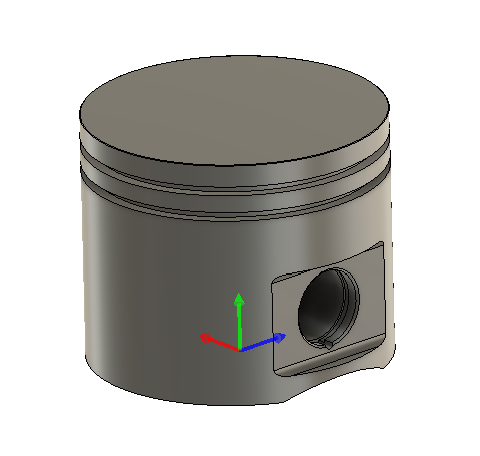
2. Material Selection: Aluminum alloys (like AlSi12) were considered for the piston due to their high thermal conductivity and low density, while Cast Iron was considered for the cylinder liner for wear resistance.
3. Thermal & Structural Analysis: Boundary conditions were applied to represent the combustion stroke, with a focus on the piston crown, where heat and pressure are most intense.
Results
1.Thermal Insight: Simulations identified critical heat zones on the piston crown, providing a visual understanding of why material selection is vital for engine longevity.
A-Temperature
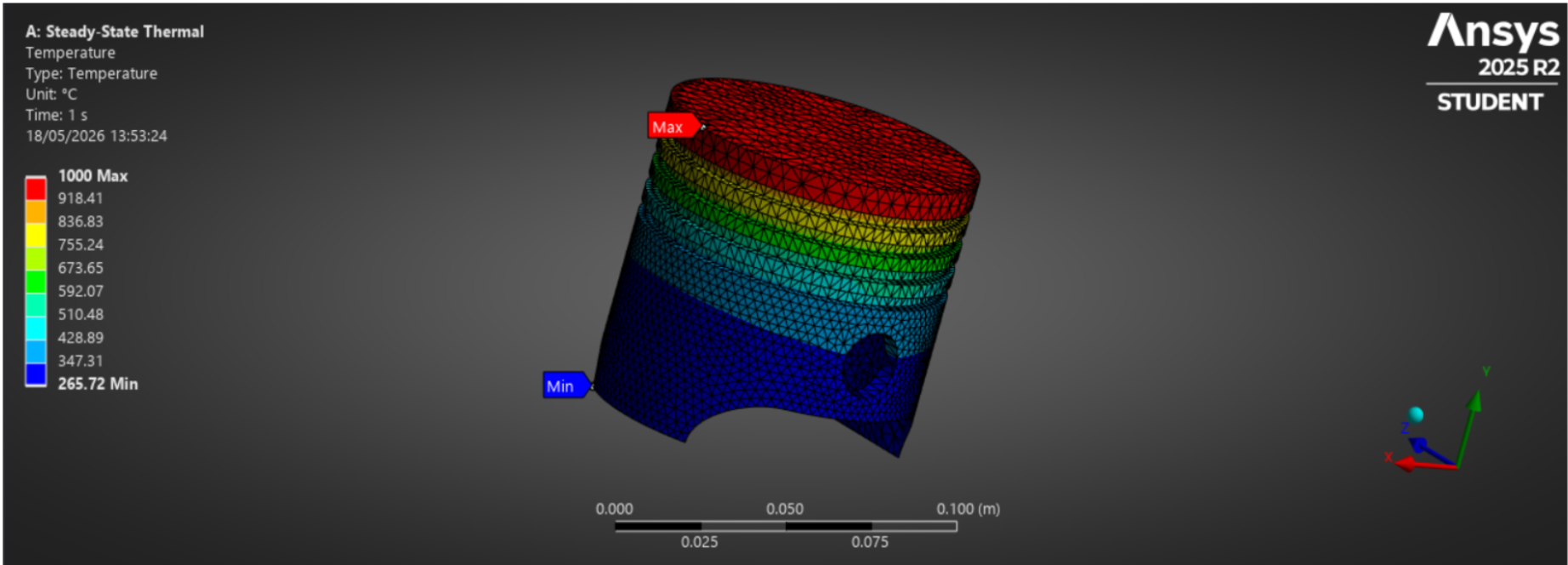
Temperature Range: Temperature varies from 265.72°C (blue) to 1000°C (red).
Temperature Distribution: The highest temperatures are found at the piston crown (top surface), which is in direct contact with the combustion gases.
Thermal Gradient: As you go down from the crown to the piston skirt, there is a sharp temperature drop. This gradient is of interest for thermal expansion and for points of possible stress near the ring grooves.
Heat Dissipation: The cooler temperatures of the skirt imply that heat is being effectively drawn off. This is likely through the cylinder walls (via piston rings) and the underside of the piston (via oil cooling/splash).
B-Total Heat flux
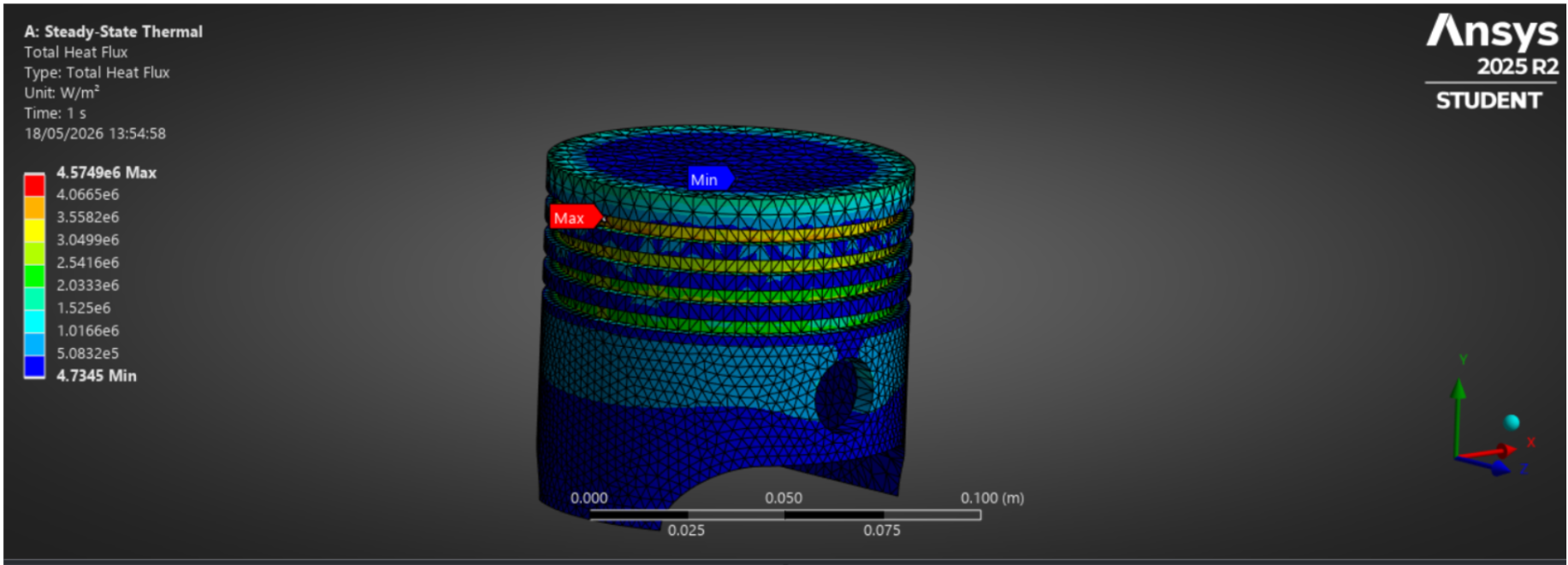
Magnitude: The maximum heat flux is 4.57 x 10^6 W/m^2.
Primary Heat Path (The Ring Zone): Observe that the "Max" indicator and the bright red/yellow zones seem to focus on the piston ring grooves. This confirms that the rings are the main path for heat to leave the piston and enter the cylinder wall (and ultimately the coolant).
Min Flux at Center: Interestingly, the center of the piston crown has a “Min” value (dark blue). This is the hottest area in terms of temperature, but the flow of heat is lower here as the energy has to travel laterally towards the edges to find a conduction path out of the component.
Conclusion/Future Scope
The project effectively moves away from merely studying SI engines towards actively designing them. By concentrating on the workflow process of current technologies, we have built our base intuition of mechanical systems. Future versions may involve the design of a valvetrain system, as well as hybridizing the engine into electric propulsion.
References
1-Research and analysis of a thermal optimisation design method for aluminium alloy pistons in diesel engines:
https://www.sciencedirect.com/science/article/pii/S2214157X23009735
2-Ambarev, K., & Taneva, S. (2025). Thermal and structural analysis of a gasoline engine piston at different boost pressures. Engineering Proceedings, 100(1), 38
https://www.mdpi.com/2673-4591/100/1/38
3. Design of piston head - https://youtube.com/playlist?list=PLQQzmqVPb_-1GjK4T7rHj5aUVzVn0vZiC&si=rmgRZPg_lAYgyau6
Gmeet link: meet.google.com/nwx-ajgb-tpn
Mentors & Mentees:
Mentors:
1. Dhruva S - 241ME120
2. Omkar Kharade - 241ME120
3. Pramathesh Vishwanath - 241ME341
Mentees:
1. Arjun Surendra Poojary - 251ME110
2. Aryan Thomas - 251ME209
3. Hruthick V - 251ME125
4. Kaushik Janorkar - 251ME222
Report Information
Report Details
Created: May 19, 2026, 10:07 a.m.
Approved by: None
Approval date: None
Report Details
Created: May 19, 2026, 10:07 a.m.
Approved by: None
Approval date: None