

Coupled O₂/H₂O Diffusion Modelling of AlOx-Based Multilayer Food Packaging for Long-Duration Space Mission Shelf-Life Prediction
Abstract
Abstract
Google Meet link: meet.google.com/ycj-penp-wpo
1. Aim
To model O₂ and H₂O vapour transport through an AlOx-based multilayer food packaging film, compare two COMSOL diffusion models, and determine whether the package can meet a 5-year space-mission shelf-life target.
2. Literature Survey and Technologies Used
- Space Mission Requirement — NASA’s planetary and outpost missions (e.g., Mars) require food to stay safe and nutritious for ≈5 years without refrigeration. Current ISS packaging is designed for much shorter cycles and does not meet this standard.
- Why Multilayer Films? — Each layer serves one role: PET provides structural rigidity, PE enables heat-sealing, and AlOx acts as the gas/moisture barrier. This division of roles is the industry standard for high-barrier food packaging.
- AlOx in Practice ( The Defect Problem )— In theory, a perfect aluminium oxide crystal is nearly impermeable. In practice, real AlOx coatings deposited on flexible films always contain pinholes and microcracks formed during vapour deposition, as well as additional cracking when the film is wound, cut, or sealed. These defects act as fast-diffusion paths and can raise the effective permeability to 10–100× the theoretical value. This is captured in the model by the defect factor f_d = 10, which multiplies the ideal AlOx diffusivity to obtain an effective diffusivity: D_eff = f_d · D_ideal. A defect factor of 10 was selected as a representative order-of-magnitude estimate consistent with literature-reported AlOx coating degradation and pinhole effects.
- Diffusion Theory Foundation — Gas transport follows Fick’s Laws; Henry’s Law links external pressure to dissolved concentration inside each layer. A resistance-in-series model (R = L/D per layer) provides the analytical and COMSOL numerical framework.
Technologies Used: COMSOL Multiphysics
3. Methodology
The methodology has four parts:
- Model set-up
- Governing theory and equations
- The two COMSOL diffusion models with their results
- Calibration to the 5-year target.
Only the two diffusion models are run in COMSOL; it then solves the transient diffusion PDE and yields the steady-state flux, which is then used to derive shelf-life values analytically from the headspace mass-balance equation. The 5-year calibrated case is derived analytically from the model outputs.
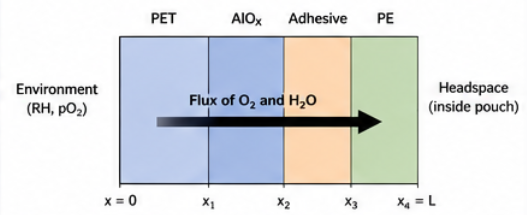
Fig. Schematic of 4-layer packaging film
A. Model Set-Up
A 1D geometry is created along the film thickness direction x. Four contiguous domains represent PET, AlOx, adhesive, and PE. Two Transport of Diluted Species interfaces are defined in COMSOL: one for O₂ (c_O₂), one for H₂O (c_H₂O). Each layer is assigned its own Arrhenius diffusivity.
Layer |
Material |
Role |
Thickness |
| 1-PET | Polyethylene terephthalate | Structural substrate | 12 μm |
| 2-AlOx | Al₂O₃ ceramic coating | Dominant gas/moisture barrier (rate-limiting) | 30 nm |
| 3-Adhesive | Polyurethane adhesive | Bonding layer | 2 μm |
| 4-PE |
Polyethylene |
Heat-sealable inner layer | 50 μm |
Operating conditions:
T = 298.15 K
Humidity Conditions
External RH = 50 %
RH Threshold = 45 % (conservative threshold selected for highly moisture-sensitive freeze-dried and low-water-activity space foods)
Oxygen Conditions
External pO₂ = 0.21 atm
Initial pO₂ = 100 Pa
Threshold pO₂ = 200 Pa (= 0.2 % O₂, assuming 1 atm total pressure)
Package Parameters
Headspace Volume = 100 mL
Package Area = 0.02 m²
B. Governing Theory and Key Equations
Symbol Table:
| c | Concentration |
| p | Gas Partial Pressure |
| D | Diffusivity |
|
D₀ |
Pre-exponential (Arrhenius) |
| E_a | Activation Energy |
| S | Solubility Coefficient |
| P=D·S | Permeability |
| J |
Flux through film |
|
L_i |
Layer Thickness |
| A_p | Pouch surface area |
| V_h | Headspace volume |
| R | Universal gas constant |
| t* | Predicted Shelf Life |
| OTR | Oxygen Transmission Rate |
i. Fick’s Laws of Diffusion
Fick’s First Law (steady-state flux through a layer):
J = − D · (dc/dx)
Fick’s Second Law (transient evolution — the PDE solved by COMSOL):
∂c/∂t = D · (∂²c/∂x²)
where c = concentration [mol/m³], D = diffusivity [m²/s], x = position [m], t = time [s].
ii. Henry’s Law
Converts gas partial pressure at each boundary into dissolved concentration in the polymer:
c = S · p
where S = solubility coefficient [mol/(m³·Pa)], p = partial pressure [Pa]. Henry’s Law is linear and valid at the low concentrations relevant here.
iii. Arrhenius Temperature Dependence
Diffusivity in each polymer layer is temperature-dependent:
D(T) = D₀ · exp[−E_a / (R · T)]
D₀ = pre-exponential factor, E_a = activation energy [J/mol], R = 8.314 J/(mol·K), T = temperature [K]. The effective diffusivity of AlOx is several orders of magnitude lower than that of the surrounding polymer layers. This large diffusivity contrast (many orders of magnitude) confirms that AlOx governs total diffusion resistance of the laminate.
iv. Resistance-in-Series (Steady-State Flux)
Each layer opposes gas transport like a resistor. The two models differ in how they state the driving force.
Model 1 – Concentration-continuity (concentration is the continuous variable):
J_ss = (c_out − c_in) / Σ(L_i / D_i)
Model 2 – Partition / partial-pressure continuity (partial pressure is continuous; concentration may jump because S differs between layers):
J_ss = (p_out − p_in) / Σ[ L_i / (D_i · S_i) ]
Individual layer resistance: R_i = L_i/D_i (Model 1) or R_i = L_i/(D_i·S_i) (Model 2). AlOx dominates in both cases.
v. Headspace Mass Balance and Shelf-Life Equation
Gas crossing the inner film face accumulates in the sealed headspace. Using the ideal gas law:
dn/dt = J · A_p → p_headspace = n · R · T / V_h
Integrating to the failure threshold gives the shelf-life prediction:
t* = (p_thr − p_init) · V_h / (J · A_p · R · T)
vi. Target Flux for 5-Year Calibration
Rearranging the shelf-life equation gives the maximum allowable steady-state flux:
J_target = (p_thr − p_init) · V_h / (t_target · A_p · R · T)
vii. Crank Time-Lag (Diffusion Lag Check)
τ_i = L_i² / (6 · D_i)
Using defect-adjusted effective diffusivities, the total laminate lag time (τ = L²/6D per layer, summed) is estimated to be on the order of minutes to hours — negligible compared with the multi-year storage target. (Note: using the ideal crystalline D_AlOx without the defect factor would give a lag of days or longer, which is why effective diffusivities must be used.) Therefore, long-term behaviour is primarily governed by steady-state ingress rather than by transient start-up diffusion.
C. The Two Diffusion Models
Two COMSOL simulations are run with identical geometry, layers, and Arrhenius diffusivities. They differ only in the interface condition applied at the internal layer boundaries.
Aspect |
Model 1: Concentration-Continuity |
Model 2: Partition / Partial-Pressure Continuity |
|
Interface condition |
Concentration is continuous across each layer boundary (COMSOL default). | Partial pressure is continuous; concentration may jump because solubility S differs between layers. |
| Flux equation | J = (c_out − c_in) / Σ(L_i/D_i) |
J = (p_out − p_in) / Σ[L_i/(D_i·S_i)] |
| Physical meaning | Same effective D governs bulk and interface. Consistent when D is OTR-fitted to the whole laminate. |
More rigorous: partial pressure is the true thermodynamic driving force; accounts for differing S in each layer. |
| Primary use | Main baseline. Gives the practical current-laminate shelf-life estimate. | Sensitivity/upper-bound case. Illustrates interface physics. Not a practical shelf life estimation. |
|
Typical O₂ result |
~43 days to 0.2 % O₂ threshold |
Physically inconsistent parameterisation leading to unrealistic overprediction — qualitative only |
Model 1 — Concentration-Continuity: COMSOL Results
Graph 1: O₂ Concentration Profile c_O₂(x)
Graph 2: H₂O Concentration Profile c_H₂O(x)
Graph 3: O₂ Flux vs Film Thickness
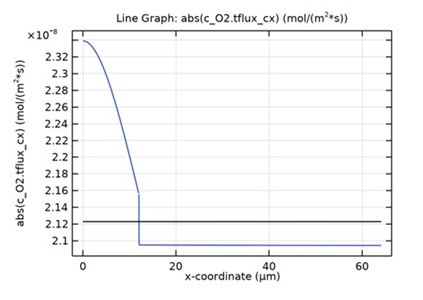
COMSOL Point Evaluation: Normal total flux at inner face vs time for O₂ and H₂O under Model 1. The simulated flux approaches a quasi-steady value rapidly relative to the multi-day shelf-life timescale ( ≤ 20 min), confirming accumulation-limited behaviour. The steady-state O₂ flux of 5.43 × 10⁻¹¹ mol/(m²·s) is used in the shelf-life calculation. The H₂O flux is independently 1.56×10⁻¹¹ mol/(m²·s) (H₂O ingress occurs more slowly than O₂ ingress under the selected conditions, indicating that the system is O₂-limited).
Shelf-Life Calculation from Model 1 Flux
t* = (200 − 100) × 10⁻⁴ / (5.43×10⁻¹¹ × 0.02 × 8.314 × 298.15) ≈ 43 days
The predicted shelf life is intentionally conservative: the model assumes defect-dominated AlOx transport, no oxygen scavengers, no secondary barrier packaging, and a strict 0.2 vol% O₂ failure threshold. The system is O₂-limited.
Model 2 — Partition / Partial-Pressure Continuity: COMSOL Results
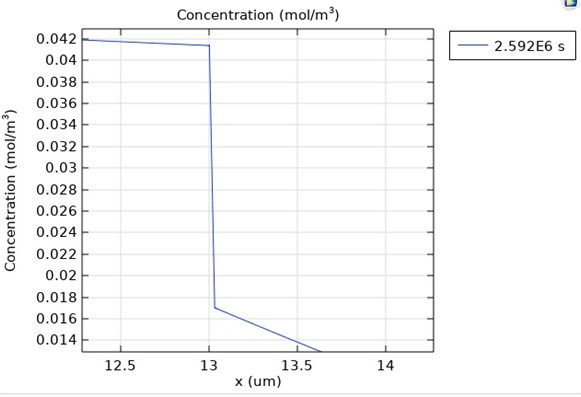
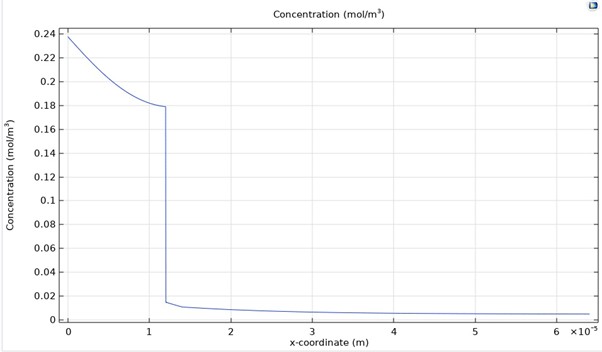
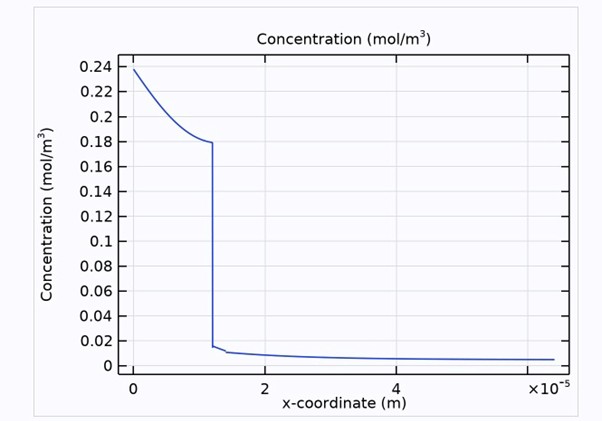
In Model 2, the concentration profile for O2 shows a discontinuous jump at the AlOx interfaces—unlike the smooth drop in Model 1—because the AlOx solubility S_AlOx is orders of magnitude lower than S_PET or S_PE. This jump in concentration while partial pressure remains continuous is the defining feature of the partition condition.
Graph 4: O2 Concentration Profile c_O2(x)
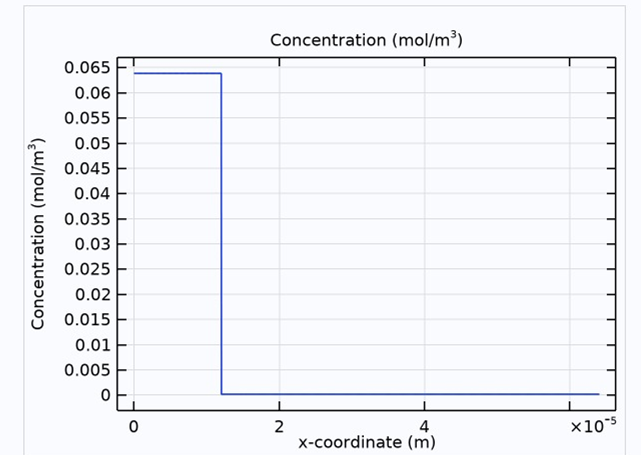
Graph 5: H2O Concentration Profile c_H2O(x)
Interpretation: Why Model 2 Produces a Nonphysical Overestimation of Shelf Life
In Model 2, R_AlOx = L_AlOx / (D_AlOx × S_AlOx). An independently assumed very low S_AlOx (~10⁻⁹ mol/(m³·Pa)) makes P = D·S extremely small. But D_AlOx was already calibrated from the whole-laminate OTR — combining this OTR-fitted D with a separate low S double-counts the AlOx barrier. This is why Model 2 is a sensitivity case only.
D. Calibration to the 5-Year Target
The 5-year target flux is back-calculated analytically from the shelf-life equation — not a separate COMSOL simulation.
- Set target: t_target = 5 years = 1.577 × 10⁸ s; p_thr = 200 Pa; p_init = 100 Pa; V_h = 10⁻⁴ m³; A_p = 0.02 m².
- Calculate J_target from the above equations: J_target = (200 − 100) × 10⁻⁴ / (1.577×10⁸ × 0.02 × 8.314 × 298.15) ≈ 1.28 × 10⁻¹² mol/(m²·s).
- Convert to OTR: OTR_target ≈ 0.012 cm³/(m²·day·atm). (Converted from molar flux using the ideal-gas molar volume at 298 K and 1 atm: V_m = RT/P = 24.46 L/mol.)
- Back-calculate required AlOx permeability: P_AlOx,5yr ≈ 1.84 × 10⁻²⁴ mol·m/(m²·s·Pa).
- Compare with baseline: Current OTR ≈ 0.5–1.0 cm³/(m²·day·atm). The 5-year target needs ~40–50× lower flux.
Main Assumptions
- Transport is 1D through the flat film. Seal leakage, edge effects, and corner flex-cracking are not modelled.
- External temperature, humidity, and O₂ level are constant (25 °C, 50 % RH, 21 % O₂) — representative of ISS habitat conditions.
- Henry’s Law is linear; effective diffusivities are Arrhenius-fitted and assumed temperature-independent at 298 K for the shelf-life calculation.
- Food-side reactions (oxidation kinetics, vitamin degradation, microbial growth) and oxygen-scavenger kinetics are not included in the base model.
- Diffusivity is assumed concentration-independent (linear Henry’s Law regime). Concentration-dependent diffusivity, which can occur at high gas activities, is not modelled.
- Radiation-induced barrier degradation is not modelled. For deep-space missions, galactic cosmic radiation may progressively damage polymer chains and ceramic coatings, potentially increasing effective permeability over the mission duration.
- The calibrated 5-year value is a design requirement derived from geometry and threshold values, not a prediction that the current film meets the target.
4. Results and Interpretation
- AlOx dominates resistance: Despite being 30 nm thick, AlOx’s extremely low diffusivity makes it the dominant resistance layer.
- System is accumulation-limited. Shelf life is set entirely by the steady-state flux into the headspace.
- Current film fails the strict target: The transparent AlOx laminate achieves ~43 days vs the 1,825-day (5-year) requirement — a 40–50× barrier gap.
- Partition model caveat: The partition-condition framework used in Model 2 is physically rigorous, but the specific parameter combination produces a strong overestimation of shelf life because AlOx resistance is effectively counted twice (independently assumed very-low S_AlOx combined with OTR-fitted D_AlOx). Model 2 is therefore treated only as a qualitative interface-physics sensitivity case, not a realistic shelf-life prediction.
Practical Feasibility of the 5-Year Calibrated Case
The calibrated target (OTR ≈ 0.012 cm³/m²/day/atm) is technically well-defined but not achievable with a standard transparent AlOx film alone. Real coatings are subject to pinhole and microcrack formation, flex-cracking during winding and pouch forming, edge seal damage, and performance degradation over multi-year storage.
|
Strategy |
Effect |
Practicality |
|
Higher-quality / thicker AlOx |
Reduces defect factor f_d; lowers effective OTR |
Feasible; increases cost and fragility |
| Aluminium foil laminate | Essentially impermeable; shelf life of years | Mass penalty ~300× vs AlOx; not transparent |
|
Oxygen scavenger sachet inside |
Absorbs O₂ that crosses the film; most accessible near-term fix | Standard commercial option; adds mass and complexity |
|
Reduced A_p or larger V_h |
Directly improves t* without changing the film |
Limited by food portion requirements |
|
Food-specific O₂ threshold |
Some foods tolerate >0.2 % O₂; threshold can be relaxed | Needs food-quality data; not a film improvement |
5. Future Scope
- Real mission temperature/RH cycling (launch, deep-space transit, Mars surface: −60 °C to +20 °C)
- Parametric sweep of defect factor f_d from 1 (ideal) to 100 (damaged) to bracket coating quality
- Oxygen scavenger kinetics integrated into the headspace ODE
- 2D or 3D geometry to capture edge, seal, and fold-region leakage
- Food-specific degradation models (vitamin loss, lipid oxidation, microbial growth)
- Experimental OTR/WVTR validation of the actual production laminate (ASTM D3985, ASTM F1249)
6. References
- Advanced food packaging systems for space exploration missions
- Crank (1975) Mathematics of Diffusion
- Minelli & Sarti (2018) time-lag in polymer membranes
- Comparative Packaging Study
- NASA Food Packaging Challenge
- TOPPAN GL-AE datasheet
- Evans et al. (2023) space food packaging review
Mentors: Atharva, Dnyaneshwari
Mentee: Kashinath
Report Information
Team Members
Team Members
Report Details
Created: May 18, 2026, 5:56 p.m.
Approved by: None
Approval date: None
Report Details
Created: May 18, 2026, 5:56 p.m.
Approved by: None
Approval date: None