

HemoFlow Numerics
Abstract
Abstract
Gmeet:
https://meet.google.com/mbg-ectb-omi?hs=122&authuser=1
Introduction
The Cardiovascular system plays a crucial role in transporting oxygen and various other essential substances. Blood flow in arteries is extremely complex especially at the regions where there can be an abrupt change in geometry. Artery bifurcation is of a lot of interest because they influence how blood flows and are often associated with cardiovascular diseases such as atherosclerosis.
A bifurcating artery refers to division of an artery into two smaller arteries. At the region of branching, the blood flow experiences variation in pressure, velocity and wall shear. This often leads to disturbed flow pattern, recirculation zones, and non-uniform stress distribution.
Computational Fluid Dynamics has emerged as an effective tool for analysing blood flow behaviour in arteries. Using CFD techniques, it is possible to simulate fluid motion within complex geometries and study parameters such as velocity distribution, pressure variation, streamline patterns, and wall shear stress without performing experiments.
In this project, a three-dimensional bifurcating artery model is analysed using CFD techniques to study the hemodynamic characteristics of blood flow. The geometry is modelled and meshed appropriately, and suitable boundary conditions are applied for simulation. The study primarily focuses on understanding the variation of flow parameters within the bifurcation region and identifying regions prone to flow separation and recirculation.
Aim:
- To develop a 3D geometric model of a bifurcating artery.
- To simulate steady, laminar blood flow using CFD techniques.
- To analyze velocity profiles, pressure drop, and wall shear stress distribution.
- To identify regions of flow separation and recirculation.
- To understand the hemodynamic factors influencing arterial diseases.
Governing Equations
The flow of blood through the bifurcating artery is governed by the principles of conservation of mass and conservation of momentum. In this study, blood is assumed to be an incompressible Newtonian fluid under steady laminar flow conditions.
Continuity Equation
The continuity equation represents the conservation of mass for incompressible flow:
∇⋅V=0
where V represents the velocity vector of the fluid.
Navier–Stokes Equation
The conservation of momentum for incompressible Newtonian flow is governed by the Navier–Stokes equation:
ρ(V⋅∇V)=-∇P+μ∇2V
where:
ρ= density of blood
P= pressure
μ= dynamic viscosity of blood
V= velocity vector
These equations are solved numerically using the finite volume method in ANSYS Fluent to obtain the flow characteristics within the bifurcating artery.
Geometry
A 3d geometry model of the bifurcating artery was used for running CFD calculations. The geometry represents a parent artery dividing into two daughter arteries through a smooth bifurcation.
Meshing
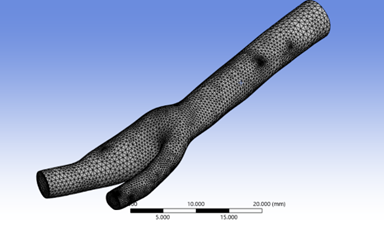
The geometry was first imported to Ansys and various meshing techniques were used for a better mesh quality.
The meshing techniques used for refinement are listed below:
1) Body Sizing
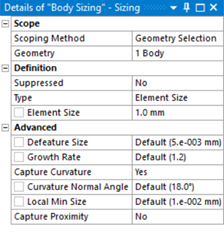
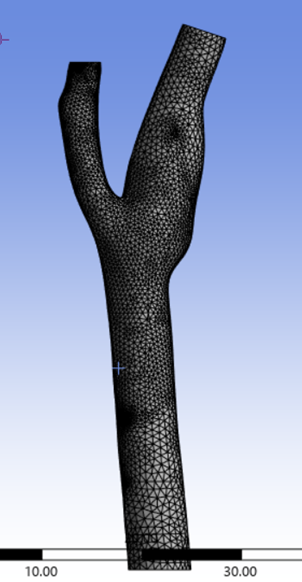
2) Body sizing was done again but this time with a sphere of influence near the bifurcating region to have finer mesh quality near that region
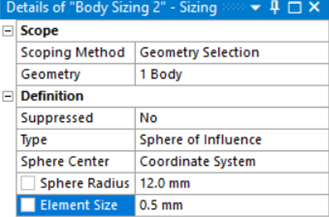
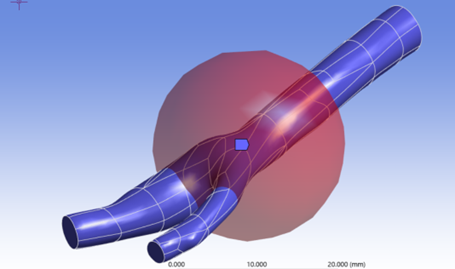
Sphere of influence
3) Inflation. This is used to make the mesh more uniform near the edges of the geometry; this will help to capture near wall behaviour in the flow including boundary layer development
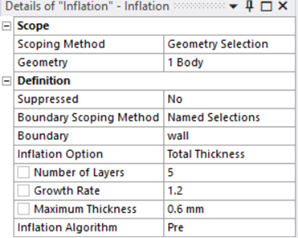
Final Mesh
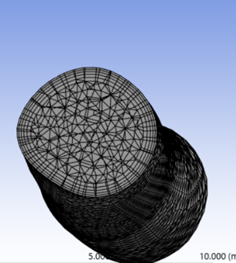
Cross sectional area showing effect of inflation
Boundary Conditions and Solver Setup
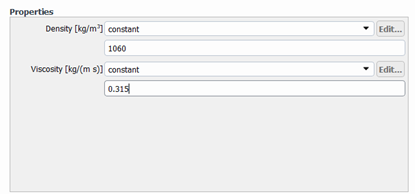
Material Properties
Boundary Conditions
Inlet:
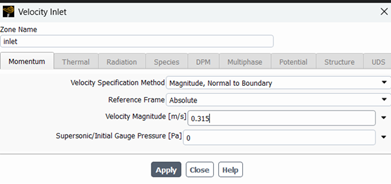
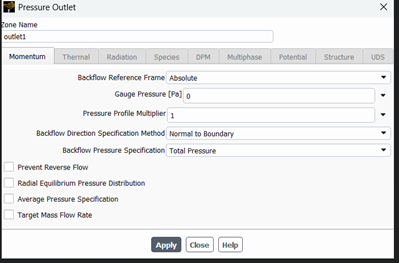
Outlet:
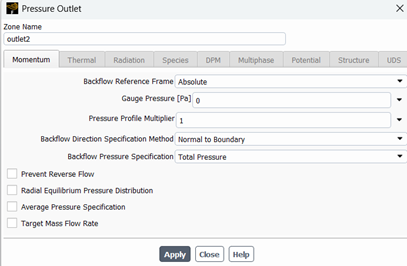
Solver Setup:
The blood within the artery was assumed to be steady, incompressible and laminar in nature. Based on inlet velocity, arterial diameter, and fluid properties, the Reynolds Number (Re) is found within the Laminar range. Therefore, a laminar flow model was used for this analysis.
A velocity inlet boundary condition with a pressure outlet condition was imposed. The walls were considered rigid, impermeable and no slip condition was applied.
The numerical solution was iterated till convergence was achieved. This solution was then further used for analysis of other parameters.
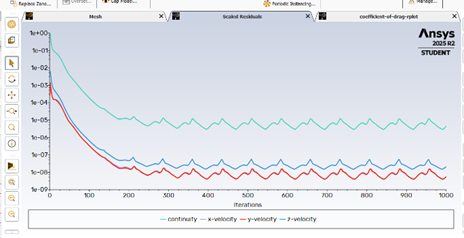
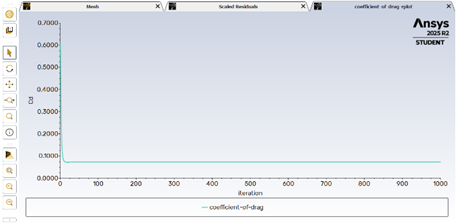
Plots showing convergence of the solver setup
Results and Discussion
Velocity Distribution
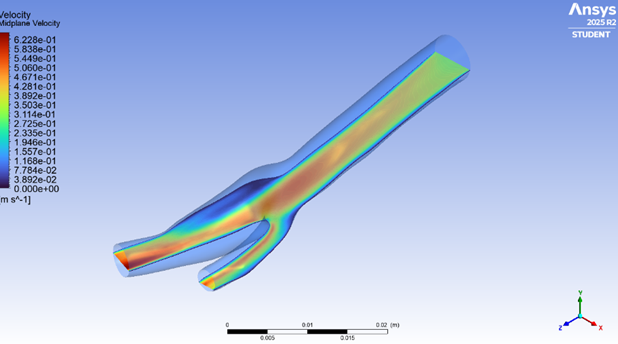
Velocity Contour of the Bifurcating Artery
A higher velocity magnitude is observed near the centre of the artery compared to the arterial walls and that is due to the no slip boundary condition which was applied. When the flow approaches the bifurcating region there is a redistribution of velocity due to the fact that the parent artery splits into two daughter arteries. The flow accelerates locally near the bifurcation due to reduction in flow area and change in the direction of flow. This is represented by higher velocity near the central portion of daughter branches. The given contour also indicates the presence of low velocity near the inner walls and this is due to the recirculation effect. The velocity profile is also smooth and continuous within the artery and this remains consistent with our initial assumptions of steady laminar flow.
Pressure Distribution
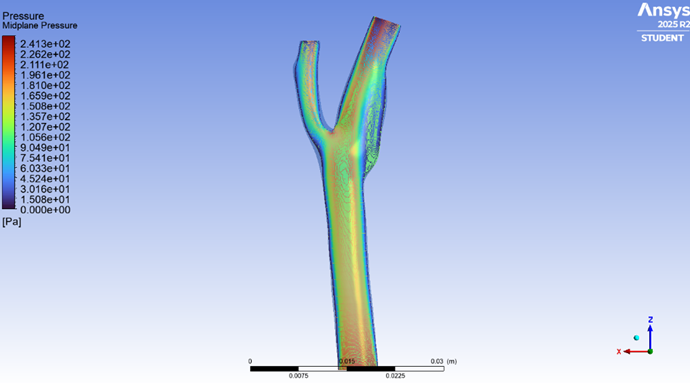
Pressure Contour of the Bifurcating Artery
The contour indicates a high-pressure region near the inlet of the artery while the pressure decreases along the direction of blood flow. When the flow enters the bifurcating region pressure is redistributed because of the change in geometry. Noticeable pressure gradient is seen near the branching region which can indicate the influence of viscous and inertial effects on the flow behaviour.
Velocity Vector Analysis
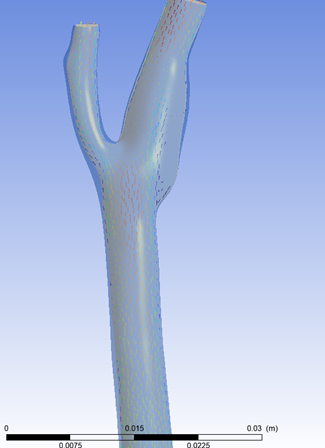
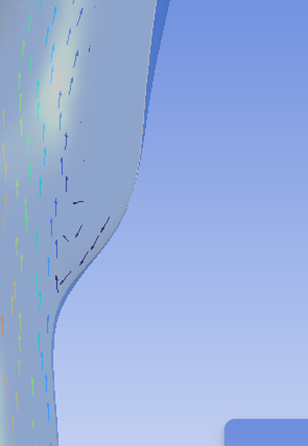
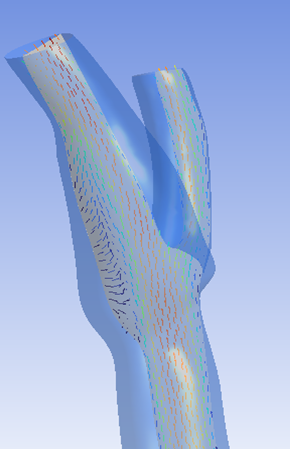
Velocity Vector Plot in the Bifurcation Region
A uniform flow pattern is observed near the central core of the parent artery. When the flow approaches the bifurcating region, it becomes complex due to the sudden change in geometry.
Localized recirculation zones can be observed near the outer wall of the bifurcating region. Here several velocity vectors exhibit reversed or very disturbed flow pattern. These recirculation zones are formed due to high pressure gradient and flow separation caused by expansion and curvature of the geometry. Presence of these recirculation zones initiate and help in the progression of atherosclerotic plaque formation within arterial bifurcations.
Streamline Analysis
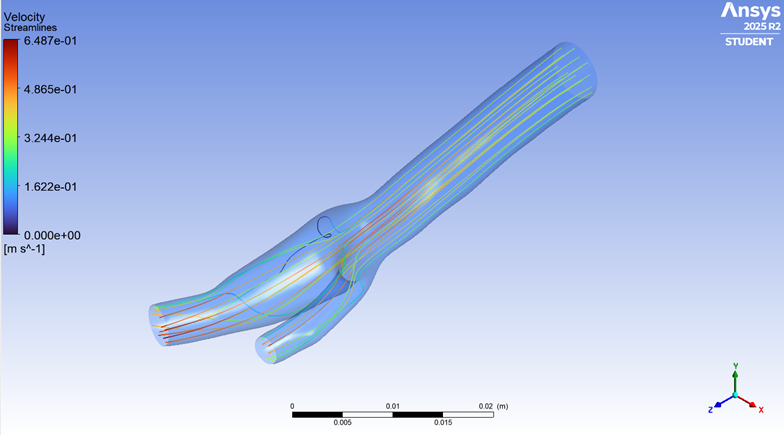
Streamlines of Blood Flow in the bifurcating region
The streamlines here demonstrate the division of flow from the parent artery to the daughter artery. A smooth and organized flow pattern is observed in the straight section of the artery, here the streamlines are almost parallel to the flow direction. When the flow approaches the bifurcation region, there is a very noticeable change in the streamline curvature due to the abrupt change in geometry. This streamline pattern also clearly demonstrates the recirculation effect that was discussed earlier. Small circulating hoops are observed near the bifurcating walls.
Wall Shear Stress Distribution
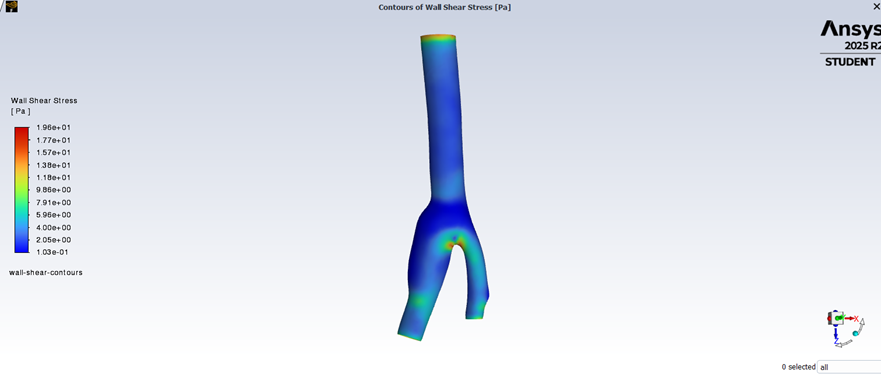
Wall Shear Stress (WSS) contour of the bifurcating artery
A localized high wall shear stress region can be seen near the apex of bifurcation this because the blood flow undergoes acceleration and directional change while entering the daughter branches of the artery. The increase of velocity gradient near the wall results in higher stress value. There is a lower stress region near the bifurcating wall due to the recirculation effect.
The wall shear stress distribution obtained is of great biomedical importance. The regions with abnormal shear conditions are associated with endothelial dysfunction and the development of atherosclerotic plaque formation.
Conclusion
A CFD analysis of blood flow through a three-dimensional bifurcating artery was performed using Ansys Fluent. The study investigated various important hemodynamic parameters such as pressure variation, velocity distribution and wall shear stress characteristics.
The results which were obtained demonstrated flow distribution. It also demonstrated localized recirculation and disturbed flow structure near the bifurcating arterial walls.
The study highlights influence of the geometry of artery on blood flow and it also provides insight into conditions associated with diseases such as atherosclerosis. The present work also builds a foundation which can be used for investigating pulsatile flow, non-Newtonian blood behaviour.
Future Scope
- Incorporation of pulsatile blood flow conditions.
- Modelling blood as a non-Newtonian fluid.
- Fluid-structure interaction considering elastic arterial walls.
- Investigation of stenosed or diseased arteries.
References
https://www.ahajournals.org/doi/10.1161/01.ATV.5.3.293
https://www.simscale.com/blog/academic-biomedical-workshop/
MENTEES
- Devam Patel
MENTORS
- Kshihtij Narayan Praveen
- Garvit Surana
- Jainam Jain
Report Information
Report Details
Created: May 18, 2026, 2:35 p.m.
Approved by: None
Approval date: None
Report Details
Created: May 18, 2026, 2:35 p.m.
Approved by: None
Approval date: None