

INVISIBLE INK
Abstract
Abstract
Image Steganography Using Python and Pillow
Summary
This project implements image steganography using Python and the Pillow library. Secret text messages are hidden inside PNG images by modifying the Least Significant Bits (LSB) of RGB pixel values and later extracted back without visibly affecting the image quality.
Google meet lik : https://meet.google.com/whx-rrmt-xns?hs=122&authuser=1
Aim
To hide secret messages inside images using LSB steganography.
To implement image encoding and decoding using Python.
To understand basic image processing and bitwise operations.
Introduction
Steganography is the technique of hiding secret information inside another file or medium. In this project, secret text messages are hidden inside PNG images using Least Significant Bit (LSB) encoding. Python and the Pillow library are used to modify image pixels and later extract the hidden message without visibly changing the image.

Original Image

Modified Image
Literature Survey and Technologies Used
Literature Survey
Image steganography is widely used in information security, watermarking, secure communication, and digital authentication systems. Among different steganographic methods, Least Significant Bit (LSB) embedding is one of the simplest and most commonly used techniques because of its ease of implementation and low visual distortion.
PNG images are generally preferred for LSB steganography because they use lossless compression, unlike JPEG images which use lossy compression and may destroy hidden data.
Technologies Used
- Python
- Pillow (PIL) Library
- Bitwise Operations
- ASCII/Binary Encoding
- PNG Image Processing
Methodology
1. Reading the Image
- The cover image is opened using the Pillow library and converted into RGB format. Pixel data is extracted from the image.
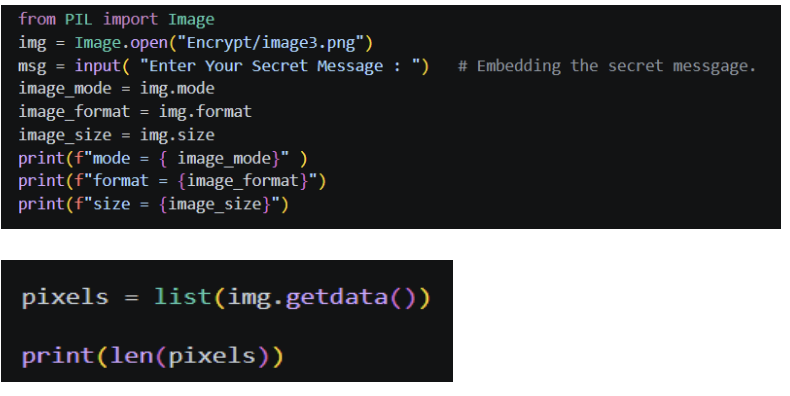
2. Message Conversion
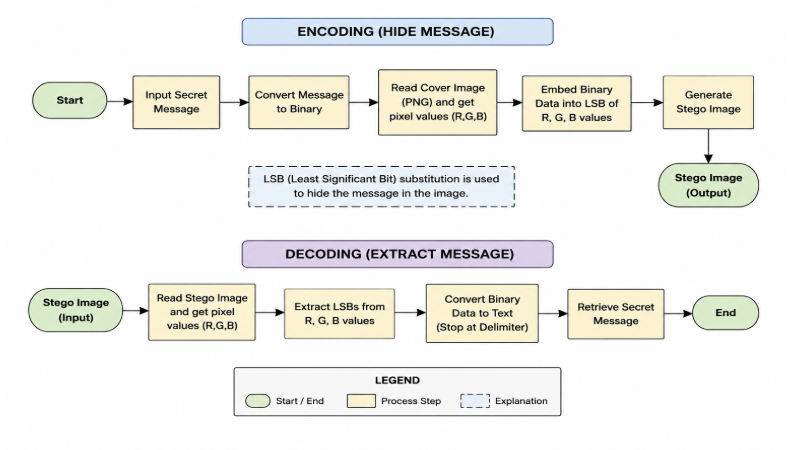
- The secret message entered by the user is converted into binary format using ASCII encoding. A delimiter (11111111) is appended to mark the end of the message.
3. LSB Embedding
- Each pixel contains RGB values. One secret bit is embedded into the Least Significant Bit of each RGB channel. Since only the last bit changes, the visual appearance of the image remains almost identical.
4. Saving the Stego Image
- The modified pixel data is inserted back into the image and saved as a new PNG image.
5. Message Extraction
- During decoding, the LSBs of RGB values are extracted from the stego image. The extracted bits are grouped into 8-bit binary values and converted back into characters to reconstruct the original hidden message.
Results
The project successfully hides secret text messages inside PNG images and retrieves them accurately during decoding. The generated stego image visually appears almost identical to the original image.
The project was tested with:
- Short messages
- Messages containing spaces
- Different message lengths
The decoding process correctly reconstructed the original messages.
Conclusion
This project demonstrates a working implementation of image steganography using LSB encoding. It provides practical understanding of:
- Binary manipulation
- Bitwise operations
- Image pixel processing
- Data hiding techniques
The project successfully achieves secure hidden communication without visibly altering the image.
Future Scope
Possible future improvements include:
- Encrypting the message before embedding
- Supporting larger file types
- Password-protected decoding
- Audio/video steganography
References / Links
Project By:
Mentors:
- Ankit kr
- Aman Nagpal
- Bhavesh Khairnar
Mentee:
- Pratibha
- Sharvi Chaudhari
- Ayan Saleem
- Siddharth Chakravarhy
Report Information
Report Details
Created: May 14, 2026, 10:46 p.m.
Approved by: None
Approval date: None
Report Details
Created: May 14, 2026, 10:46 p.m.
Approved by: None
Approval date: None