

VibeBalancer - Configurable HTTP load balancer with failure handling
Abstract
Abstract
VibeBalancer – IEEE Envision Project Report
VibeBalancer – IEEE Envision Project Report
Distributed Systems and Backend Engineering Project
Abstract
VibeBalancer is a distributed systems and backend engineering project focused on understanding concurrency, asynchronous programming, load balancing, fault tolerance, and monitoring in modern server architectures. The project was developed using Python and FastAPI to simulate real-world backend infrastructure concepts such as blocking vs non-blocking execution, concurrent request handling, server-side threading, custom load balancing strategies, backend fault recovery, and real-time metrics collection.
The system progressively evolved from a simple FastAPI server into a fault-tolerant distributed load balancing architecture capable of handling concurrent traffic efficiently while monitoring server health and system performance.
Links
Google Meet Link: meet.google.com/cif-srkq-dvh
Github Repository: https://github.com/codebybrijesh/VibeBalancer-Tasks
Aim
To design and implement a scalable backend infrastructure system that demonstrates:
- Concurrent request handling
- Blocking vs non-blocking behavior
- Asynchronous programming
- Custom load balancing algorithms
- Fault tolerance mechanisms
- Health monitoring and metrics collection
using Python and FastAPI.
Introduction
Modern distributed systems must efficiently handle thousands of concurrent users while maintaining reliability, scalability, and fault tolerance.
Backend servers need mechanisms to:
- Process multiple requests simultaneously
- Distribute traffic across servers
- Recover from failures
- Monitor infrastructure health in real time
VibeBalancer was developed to understand these real-world distributed system concepts through practical implementation.
The project started with learning GitHub workflows and Python fundamentals, followed by building FastAPI-based servers and gradually introducing asynchronous request handling, threading, custom load balancers, fault tolerant architectures, and monitoring systems.
The project demonstrates how modern backend infrastructure works internally and how technologies like load balancers and concurrent systems improve scalability and responsiveness.
Literature Survey and Technologies Used
Literature Survey
Distributed Systems and Concurrency
Modern web applications require efficient concurrent request handling to avoid performance bottlenecks. Blocking systems process requests sequentially, reducing scalability, whereas asynchronous and concurrent architectures improve throughput significantly.
Load Balancing
Load balancers distribute traffic across multiple backend servers to improve performance and reliability.
- Round Robin
- Least Connections
Fault Tolerance
Production-grade systems must detect failed servers and reroute traffic automatically to healthy instances. Health checks and retry mechanisms ensure high availability.
Monitoring and Observability
Monitoring systems collect:
- Application metrics
- System resource utilization
- Error statistics
- Request activity
to maintain infrastructure reliability and performance.
Technologies Used
| Category | Technology |
|---|---|
| Programming Language | Python |
| Backend Framework | FastAPI |
| Concurrency | asyncio, threading |
| HTTP Client | httpx |
| Monitoring | psutil |
| API Testing | Browser / Postman |
| Version Control | Git & GitHub |
| Development Environment | VS Code |
| Operating System | Windows/Linux |
Methodology
Phase 1 – GitHub Learning and Version Control
Implementation
- Learned Git and GitHub fundamentals
- Practiced repository creation and management
- Performed push and pull operations
- Used Git Bash for version control operations
Commands Practiced
git init
git clone
git add .
git commit -m "message"
git push
git pull
git status
Outcome
This phase established understanding of collaborative development workflows and source code management.
Phase 2 – Python Fundamentals
Implementation
- Variables and data types
- Loops
- Conditionals
- Functions
- Lists and dictionaries
- Basic problem solving
Outcome
Developed a strong foundation in Python programming and backend development concepts.
Phase 3 – FastAPI Server Development
Implementation
A FastAPI server was created with multiple API endpoints:
- /
- /work
- /info
The /work endpoint simulated server-side processing delays using asynchronous execution.
Example
await asyncio.sleep(delay)
Outcome
Learned backend API development and asynchronous request handling.
Phase 4 – Blocking vs Non-Blocking Behavior and Threading
Blocking Server
time.sleep(delay)
Async Server
await asyncio.sleep(delay)
Observations
- Blocking execution processed requests sequentially
- Sequential execution of 5 requests took approximately 15 seconds
- Threaded concurrent execution reduced response time significantly
- Asynchronous servers handled overlapping requests efficiently
Outcome
Understood concurrency, threading, and asynchronous programming in backend systems.
Phase 5 – Load Balancer Implementation
Algorithms Implemented
- Round Robin
- Least Connections
Features
- Request forwarding
- Connection tracking
- Concurrent request distribution
Outcome
Learned traffic distribution strategies and scalable backend architecture design.
Phase 6 – Fault Tolerant Load Balancer
Features Added
- Health check endpoints
- Automatic unhealthy server detection
- Retry mechanisms
- Recovery detection
- Graceful failure handling
Health Monitoring
GET /health
Failure Response
503 Service Unavailable
Outcome
Understood production-grade fault tolerant distributed systems.
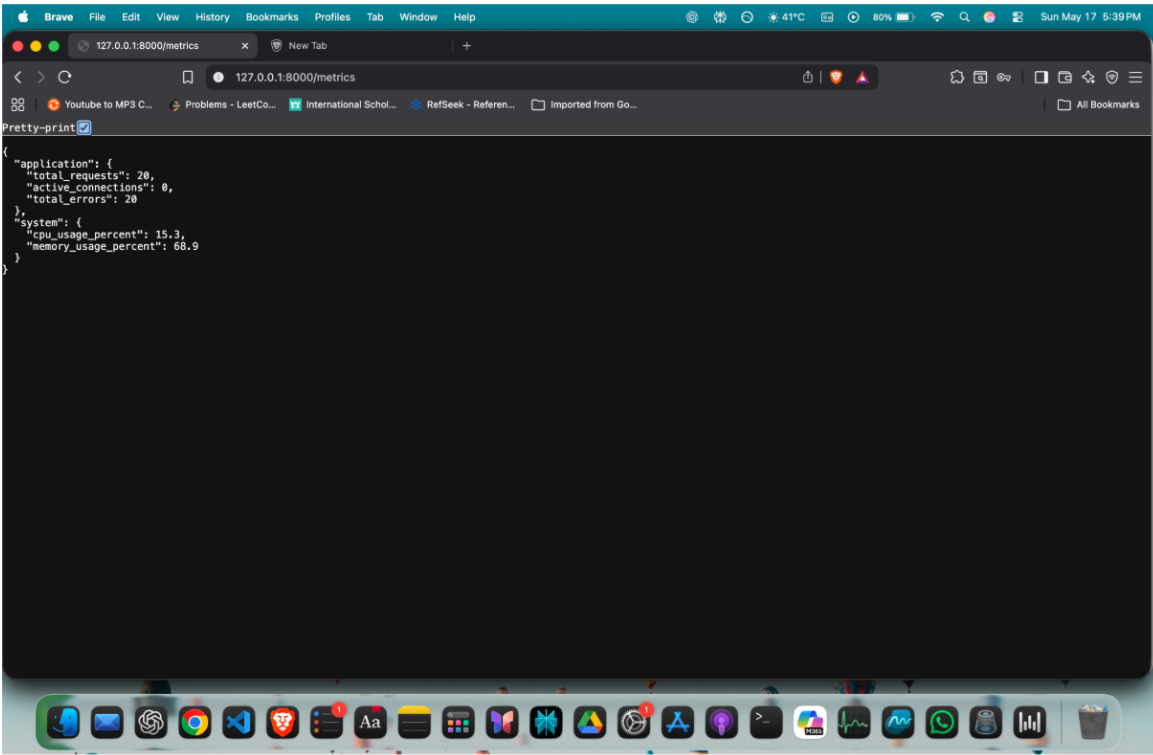
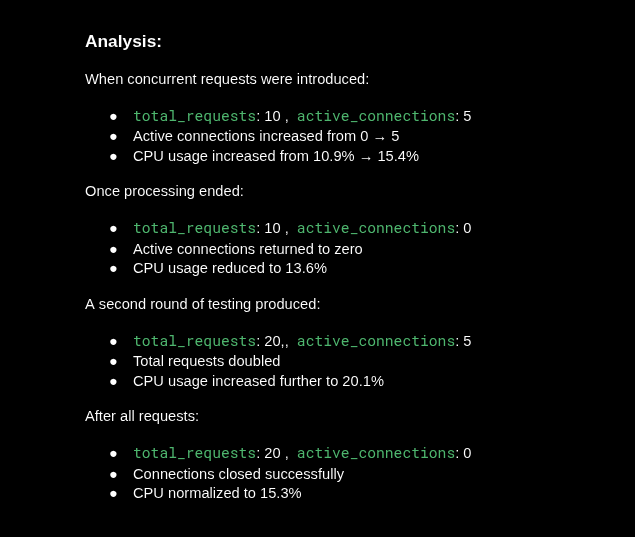
Phase 7 – Monitoring and Metrics Collection
Metrics Endpoint
- Total requests
- Active connections
- Total errors
- CPU usage
- Memory usage
Monitoring Library
psutil
Metrics Example
{
  "total_requests": 10,
  "active_connections": 0,
  "total_errors": 0
}
Outcome
Learned real-time infrastructure monitoring and observability systems.
Results
- Concurrent request handling
- Blocking vs non-blocking execution
- Thread-based concurrency
- Asynchronous backend processing
- Custom load balancing
- Round Robin and Least Connections algorithms
- Fault tolerance mechanisms
- Health monitoring systems
- Metrics and observability
The final architecture efficiently handled concurrent requests while maintaining reliability and scalability.
Conclusion
VibeBalancer successfully implemented a distributed backend infrastructure system using FastAPI and Python.
The project provided practical exposure to:
- Backend engineering
- Distributed systems
- Concurrency
- Asynchronous programming
- Load balancing
- Infrastructure monitoring
The project simulated many concepts used in real-world production systems and significantly improved understanding of scalable backend architectures.

Future Scope
- Docker-based container deployment
- Kubernetes orchestration
- Reverse proxy integration using Nginx
- Auto-scaling systems
- Prometheus and Grafana dashboards
- Distributed tracing
- Rate limiting
- Circuit breaker implementation
- Cloud deployment
- SSL and authentication integration
References
- FastAPI Documentation
- Python Documentation
- AsyncIO Documentation
- HTTPX Documentation
- psutil Documentation
- Git Documentation
- GitHub Documentation
Mentors and Mentees
Mentors
- Aadharsh Venkat
- Anirudh Nayak
Mentees
- Brijesh Sharma
- Advita Tantry
- Rahul Dhaker
- Aflah
IEEE Envision Project Report – VibeBalancer
Report Information
Team Members
Team Members
Report Details
Created: May 14, 2026, 3:20 p.m.
Approved by: None
Approval date: None
Report Details
Created: May 14, 2026, 3:20 p.m.
Approved by: None
Approval date: None