

Speech to Electrode Encoding Using Virtual Channels for Cochlear Implants
Abstract
Abstract
 Google Meet Link
GitHub Repository
https://github.com/RushilJ2603/cochlear_Implant_IEEE
Aim
To design and implement a software-based cochlear implant signal processing framework capable of converting speech into electrode stimulation patterns using ERB scaling, ACE coding and virtual channel current steering techniques.
Introduction
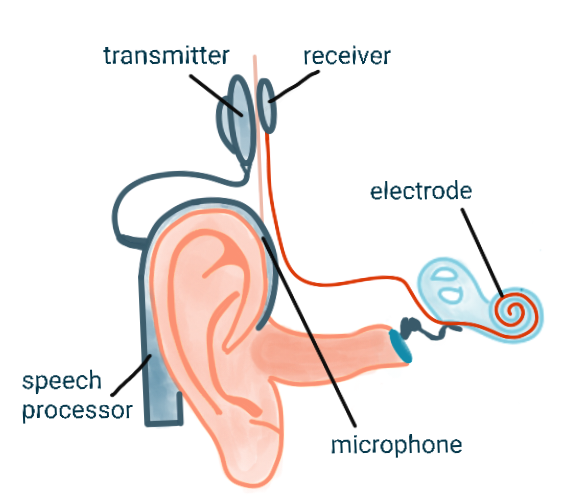
Cochlear implants are neural prosthetic devices designed to restore hearing in individuals with severe sensorineural hearing loss. Unlike hearing aids that amplify sound, cochlear implants bypass damaged hair cells and directly stimulate the auditory nerve using intracochlear electrodes. Modern cochlear implant systems rely on sophisticated speech coding strategies such as CIS and ACE to encode speech information efficiently. However, the number of physical electrodes is limited, reducing spectral resolution. Virtual channel current steering improves this limitation by creating intermediate pitch percepts between adjacent electrodes, effectively increasing the number of distinguishable channels.
Literature Survey and Technologies Used
The project is based on research related to ACE (Advanced Combination Encoder), CIS (Continuous Interleaved Sampling), and virtual channel current steering techniques. Previous studies demonstrated that current steering can significantly improve spectral discrimination and speech perception in cochlear implant systems.
The implementation uses:
- Python for modular development
- NumPy and SciPy for DSP operations
- Librosa for audio preprocessing and feature extraction
- Matplotlib for visualization and electrodograms
- Butterworth filterbanks for spectral decomposition
Methodology
1. Audio Preprocessing
- Audio loading and normalization
- Pre-emphasis filtering
- Framing and windowing
2. Filterbank Analysis
ERB-spaced Butterworth filters separate the signal into frequency bands corresponding to cochlear electrodes.
3. Envelope Extraction
- Rectification and low-pass filtering are used to obtain temporal envelopes.
- ACE n-of-m maxima selection chooses dominant channels.
4. Virtual Channel Current Steering
- Adjacent electrodes stimulated simultaneously using steering coefficient
- Intermediate pitch channels generated between electrodes.
5. Dynamic Range Compression
Loudness growth functions compress acoustic amplitudes into electrical stimulation ranges.
6. Pulse Generation and Vocoder
- Biphasic CIS pulse trains generated.
- Vocoder reconstruction produces speech-like perceptual output.
7. Visualization Modules
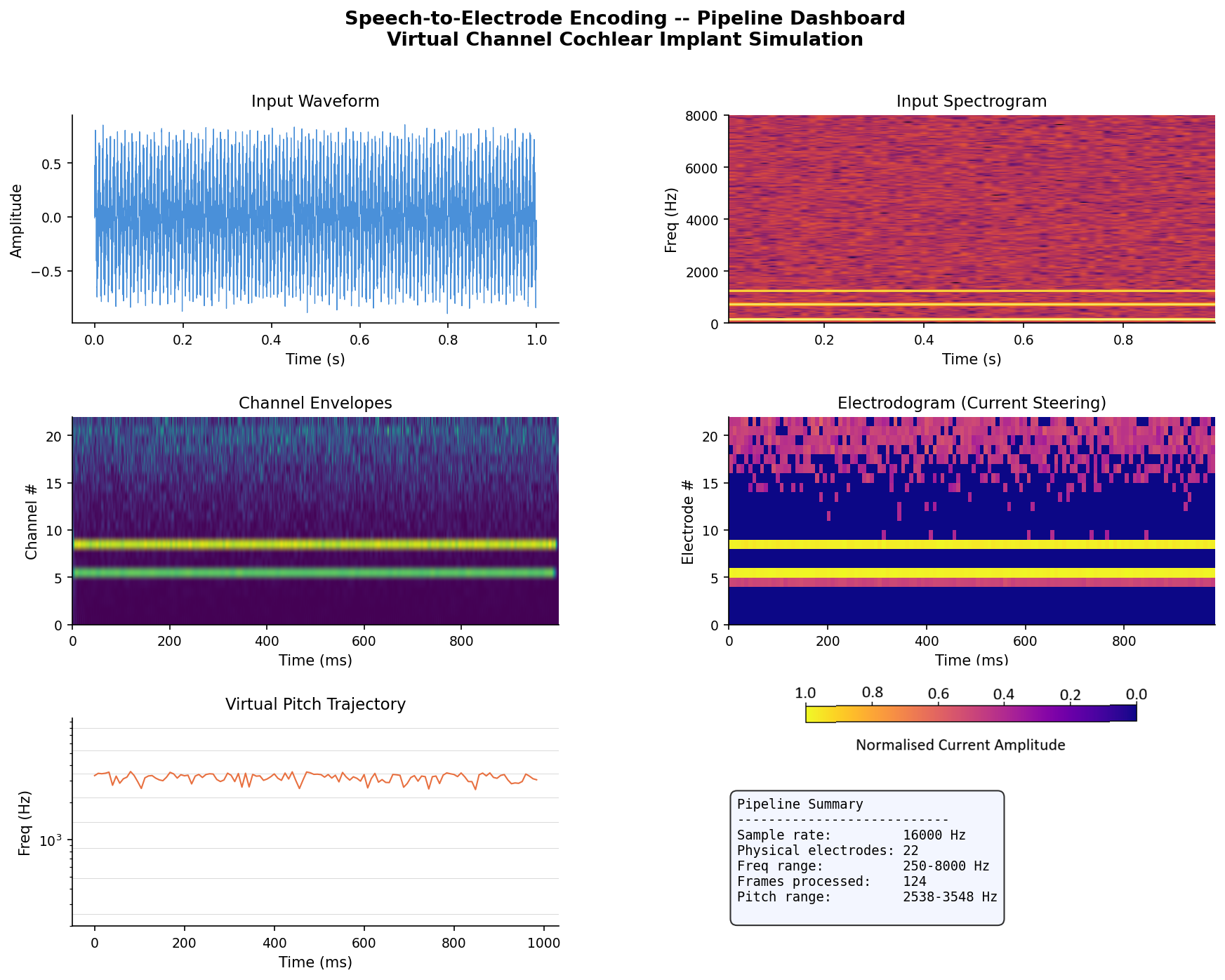
- Electrodograms : visualisation of electrode activation over time
- Filterbank Responses : frequency responses of ERB-spaced channels
- Envelope Trajectories : temporal envelope evolution in each channel
- Pitch Tracking & Stimulation Plots : estimated pitch and electrode current activity
Results
Conclusion and Future Scope
The project successfully demonstrates a modular cochlear implant speech processing simulator with ACE coding and virtual channel current steering. The system improves spectral representation beyond the limitation of physical electrodes and provides a strong foundation for advanced cochlear implant research.
Future improvements may include:
- Real-time processing pipelines
- FPGA or embedded DSP implementation
- Adaptive AI-based channel optimization
- Patient-specific fitting strategies
- Deep learning-assisted speech enhancement
References
- Wilson, B. S., et al. (1991). Better speech recognition with cochlear implants. Nature, 352, 236–238.
- Loizou, P. C. (1998). Mimicking the human ear. IEEE Signal Processing Magazine, 15(5), 101–130.
- Moore, B. C. J., & Glasberg, B. R. (1983). Auditory-filter bandwidths and excitation patterns. J. Acoust. Soc. Am., 74(3), 750–753.
- Donaldson, G. S., et al. (2005). Improving speech understanding with current steering. Ear and Hearing, 26(4S), 109S–119S.
- Koch, D. B., et al. (2007). Combining current steering and current focusing. Cochlear Implants International, 8(4), 202–213.
- Shannon, R. V., et al. (2004). Speech recognition with primarily temporal cues. Science, 303, 1780–1782.
- Vandali, A. E., et al. (2000). Speech perception as a function of electrical stimulation rate. Ear and Hearing, 21(6), 608–624.
- Zeng, F.-G., et al. (2002). Cochlear implant speech recognition with civil-level stimulation. J. Acoust. Soc. Am., 112(5), 1829–1842.
Mentors:
Rushil Jain, Shobitha Arun Kumar
Mentees:
K Charandheep, Chinmay Raikar, Harain Muralietharan, S Kayalselvi, Shaurya Bhatkaria, Shreya Harikumar
Report Information
Team Members
Team Members
Report Details
Created: May 14, 2026, 11:58 a.m.
Approved by: None
Approval date: None
Report Details
Created: May 14, 2026, 11:58 a.m.
Approved by: None
Approval date: None