

Data-Driven Identification of Optimal Operating Regimes for BTX Separation: Direct Sequence and Divided Wall Column
Abstract
Abstract
Aim
To identify and compare optimal operating conditions for BTX separation in two distillation configurations, a conventional two-column Direct Sequence (DS) and a thermally coupled Petlyuk column (the simulation equivalent of a Divided Wall Column) by statistically exploring the operating design space using and identifying distinct operating regimes through unsupervised learning clustering. The core objective is to characterise the energy-purity trade-off between the two configurations under comparable conditions.
Introduction
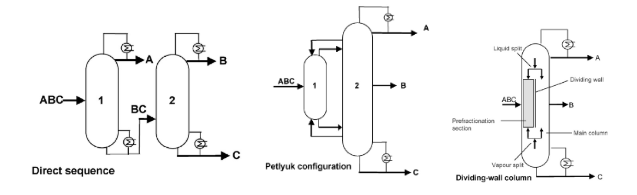
Benzene, toluene, and xylene (BTX) are high-value aromatic chemicals whose separation from mixed streams is a critical and energy-intensive step in petrochemical refining. Conventional separation is performed via a Direct Sequence (DS) of two distillation columns: the first separates benzene as the lightest component, and the second separates toluene from xylene. This process requires two reboilers and two condensers.
An alternative configuration, the Divided Wall Column (DWC), integrates this two-column separation into a single shell with one reboiler and one condenser by placing an internal dividing wall. This design is thermodynamically equivalent to the Petlyuk column which is a two-column thermally coupled system and is known to reduce energy consumption by 10–50% compared to conventional sequences [1, 2]. Pandit & Jana (2022) demonstrated quantitatively for the BTX system that an optimised DWC achieves 22.9% savings in capital cost, 30% in operating cost, and a 35% reduction in CO₂ emissions versus its conventional counterpart [3].
However, identifying good operating conditions for either configuration, especially the DWC, which has a significantly larger parameter influencing the output is non-trivial. Trial and error or heuristic exploration of this space is inefficient and may miss important operating regimes. This work addresses that challenge by using Latin Hypercube Sampling (LHS) to systematically explore the operating space of both configurations in Aspen Plus, followed by unsupervised learning using K-Means clustering to identify and characterise distinct performance regimes. The optimal cluster from each configuration is then compared to assess the energy-purity trade-off.
Literature Survey
- [1] Kiss & Rewagad (2011): Established the BTX DWC simulation framework in Aspen Plus using the equimolar BTX feed, and proposed energy-efficient PID control structures. This paper defines the base case configuration used in this work.
- [2] Errico et al. (2009): Compared energy savings and capital costs of Direct Sequence vs. Petlyuk/DWC configurations using Douglas (1988) empirical correlations, demonstrating that DWC capital cost savings are configuration-dependent and typically below the commonly cited 30% benchmark.
- [3] Pandit & Jana (2022): Applied a multi-objective NSGA-II genetic algorithm to simultaneously optimize capital cost, operating cost, CO₂ emissions, and product recovery for both a CDS and a DWC for BTX separation. Their optimal DWC (1602 kW reboiler duty) versus their optimal CDS (2485 kW combined) showed a 35% reduction in reboiler duty which is closely aligned with the energy-saving direction observed in this work through clustering.
- [4] J. Halvorsen & Sigurd Skogestad (1999): Showed that although the Petlyuk column can achieve significant energy savings, its optimal operating region is highly sensitive to disturbances and design parameters. Even small deviations from the optimum can lead to large increases in energy consumption, requiring precise adjustment of the available degrees of freedom. The study highlights that effective operation relies on feedback-based control strategies to maintain near-optimal performance.
Technologies Used
- Aspen Plus (DSWST, RadFrac, Petlyuk model, NRTL property method) for rigorous steady-state distillation simulation for both DS and DWC configurations.
- Latin Hypercube Sampling (LHS) for space-filling statistical design of experiments to systematically cover the operating parameter space of each configuration
- K-Means Clustering with Elbow Method for unsupervised machine learning to identify distinct operating regimes from simulation outputs
- Python (scikit-learn, matplotlib, pandas) for post-processing, clustering, and visualisation
Methodology
Both configurations were simulated using the equimolar BTX feed (20 kmol/hr benzene, 20 kmol/hr toluene, 20 kmol/hr xylene) with a 50% vapour quality (q = 0.5), following the case study defined by Kiss & Rewagad (2011). The key performance metrics recorded from each simulation were:
- Geometric Mean Purity (GMP) is defined as (xᴮ × xᵀ × xˣ)^(1/3), where xᴮ, xᵀ, xˣ are the mole fraction purities of benzene, toluene, and xylene in their respective product streams. GMP provides a single scalar measure of overall separation quality across all three products.
- Reboiler Heat Duty (kW) is the primary energy consumption metric, directly linked to operating cost and carbon footprint.
- Condenser Heat Duty (kw) is an additional energy consumption metric.
A. Direct Sequence (DS)
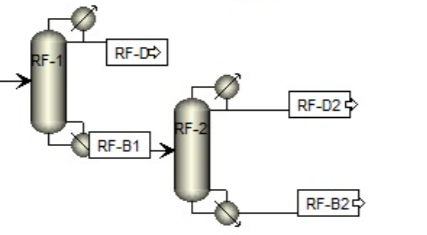
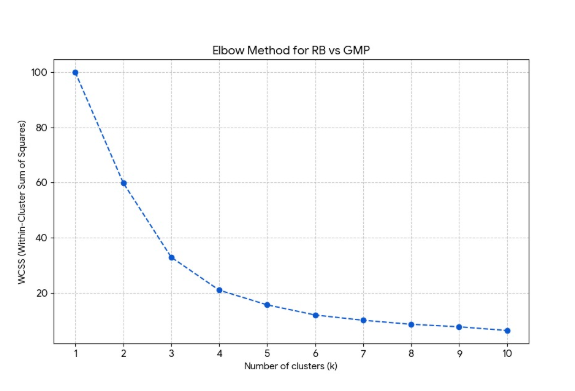
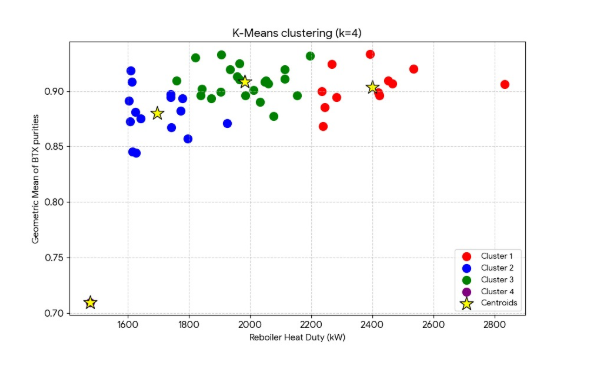
Two DSTW columns followed by RadFrac columns were configured in Aspen Plus. Column 1 separates benzene (lightest) as distillate, with the TX bottoms fed into Column 2 which separates toluene from xylene. Tray count was fixed for both columns. Key operating variables which are reflux ratio and related parameters were varied over their feasible ranges using LHS, generating 50 simulation samples. K-Means clustering (k=4, selected by elbow method - clear inflection at k=4) identified four operating regimes across the LHS sample space. Cluster 3 was identified as optimal with moderate energy (centroid reboiler duty ~1,983 kW), highest geometric mean purity (GMP ~0.908), and the largest cluster with 22 data points, indicating it represents a robust, reproducible operating region rather than an edge case.
B. Petlyuk Column (DWC)
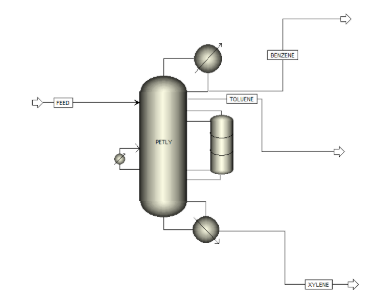
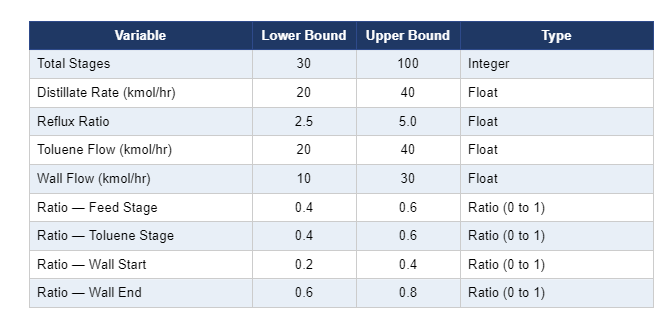
The Petlyuk column was simulated in Aspen Plus as two thermally coupled RadFrac columns with a prefractionator and a main column. Nine operating and design variables were explored via LHS, covering both geometric ratios (wall position, feed stage, side-draw location) and flow parameters (reflux ratio, distillate rate, side-draw rate). The bounds are summarised in the table below:
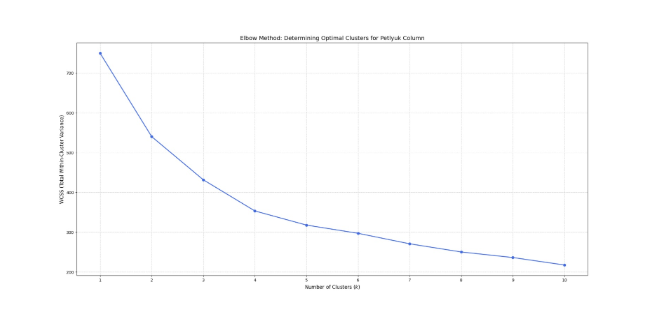
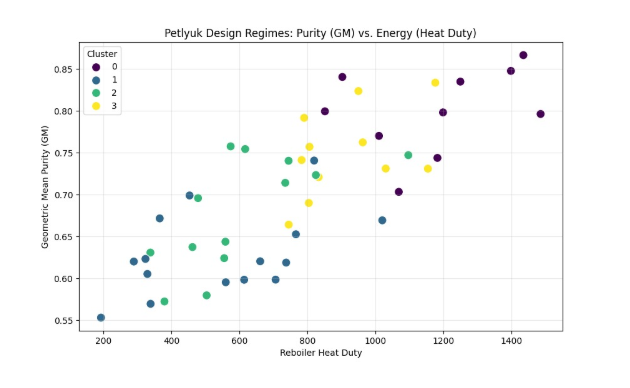
K-Means clustering (k=4) was applied to the Petlyuk simulation outputs. The elbow curve for the Petlyuk was more gradual than for DS which reflects the wider, more complex operating space but k=4 remained defensible. Cluster 3 was again identified as optimal: energy ~927 kW, GMP ~0.75, and the smallest column size at 46 stages, representing the most compact and energy-efficient viable operating point.
Results
The table below summarises the key outcomes for the optimal cluster (Cluster 3) from each configuration:
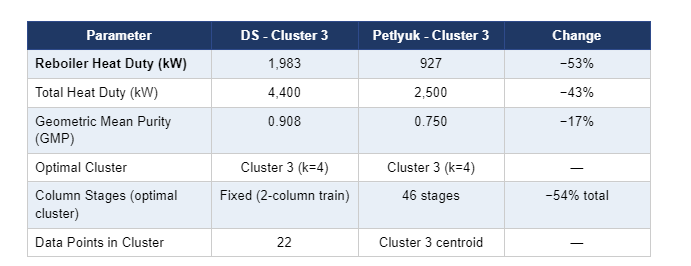
The Petlyuk column at its optimal cluster achieves a 53% reduction in reboiler duty and a 43% reduction in total heat duty compared to the DS optimal cluster. This energy saving is consistent in direction with the 35-45% OPEX reductions reported by Pandit & Jana (2022) for an optimised DWC over a conventional DS in the same BTX system, providing independent validation that the operating regime identified through LHS and clustering captures genuinely energy-efficient operating points.
The trade-off is a reduction in geometric mean purity from 0.908 (DS) to 0.750 (Petlyuk). This is partly a characteristic of the Petlyuk configuration's inherently wider operating space as lower-purity operating points coexist with high-energy-efficiency points and partly a consequence of the fixed-tray constraint applied in this study. The DS, being a simpler two-column system, converges to high-purity solutions more readily across its operating space.
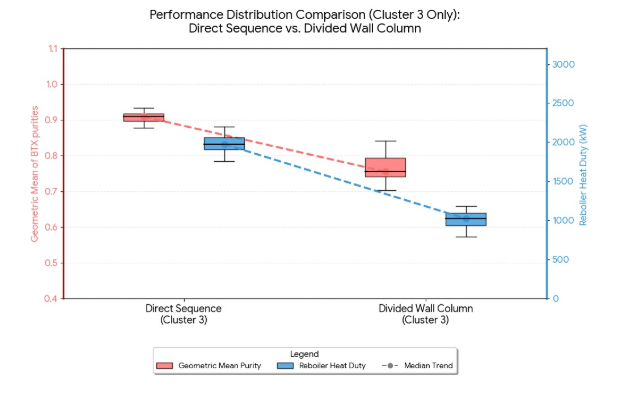
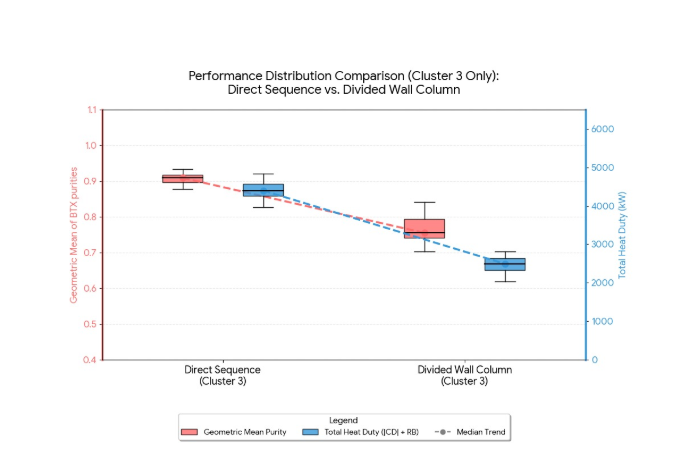
Box plot analysis of Cluster 3 (the optimal cluster) for both configurations shows that the DS cluster has a tight, narrow distribution in both purity and reboiler duty, reflecting a stable and reproducible operating regime. The Petlyuk Cluster 3 has a wider spread, which is consistent with the known sensitivity of thermally coupled columns to small changes in internal flow splits which is discussed extensively in the controllability literature [1].
Conclusions
Latin Hypercube Sampling combined with K-Means clustering successfully mapped the operating space of both Direct Sequence and Dividing Wall Column configurations for BTX separation without exhaustive simulation. The optimal operating regime for the Dividing Wall Column consumes approximately half the reboiler energy of the corresponding DS regime, confirming the energy-efficiency advantage of thermally coupled configurations reported in the literature and quantitatively consistent with the MOO-based findings of Pandit & Jana (2022) for the same system.
The purity gap between configurations (GMP 0.908 vs. 0.750) reflects a real design trade-off: the DWC's energy advantage comes with a wider, more sensitive operating space that requires careful condition selection, such as a greater reflux ratio or more number of trays. This makes the LHS + clustering approach particularly valuable as it efficiently identifies where in that space the column performs well.
Future Scope
- Techno-economic analysis (CAPEX and OPEX) using empirical correlations from Douglas (1988), following the methodology of Errico et al. (2009), to quantify cost savings alongside the demonstrated energy savings.
- Carbon footprint and water consumption analysis derived from the reboiler and condenser duty data already available from the simulations.
- Dynamic simulation and controllability analysis of the Petlyuk configuration in Aspen Dynamics, as demonstrated by Kiss & Rewagad (2011), to assess operability of the identified optimal operating regimes.
- Relaxing the fixed-tray constraint to allow stage count optimisation within the LHS framework, enabling a fairer purity comparison between configurations.
References / Links
[1] Kiss, A.A. & Rewagad, R.R. (2011). Energy efficient control of a BTX dividing-wall column. Computers and Chemical Engineering, 35(12), 2896–2904.
[2] Errico, M., Tola, G., Rong, B.G., Demurtas, D. & Turunen, I. (2009). Energy saving and capital cost evaluation in distillation column sequences with a divided wall column. Chemical Engineering Research and Design, 87(12), 1649–1657.
[3] Pandit, S.R. & Jana, A.K. (2022). Transforming conventional distillation sequence to dividing wall column: Minimizing cost, energy usage and environmental impact through genetic algorithm. Separation and Purification Technology, 297, 121437.
[4] Petlyuk, F.B., Platonov, V.M. & Slavinskii, D.M. (1965). Thermodynamically optimal method for separating multicomponent mixtures. International Chemical Engineering, 5(3), 555–561.
Report Information
Team Members
Team Members
Report Details
Created: April 8, 2026, 5:24 p.m.
Approved by: Santoshkumar Suresh Otageri [Piston]
Approval date: None
Report Details
Created: April 8, 2026, 5:24 p.m.
Approved by: Santoshkumar Suresh Otageri [Piston]
Approval date: None